Let’s tackle join() vs sleep(), two foundational thread blocking methods under Thread Fundamentals.
While both methods pause execution of the calling thread, their underlying mechanisms, dynamic conditions, and monitor lock behaviours are fundamentally different.
Core Concepts & Comparison
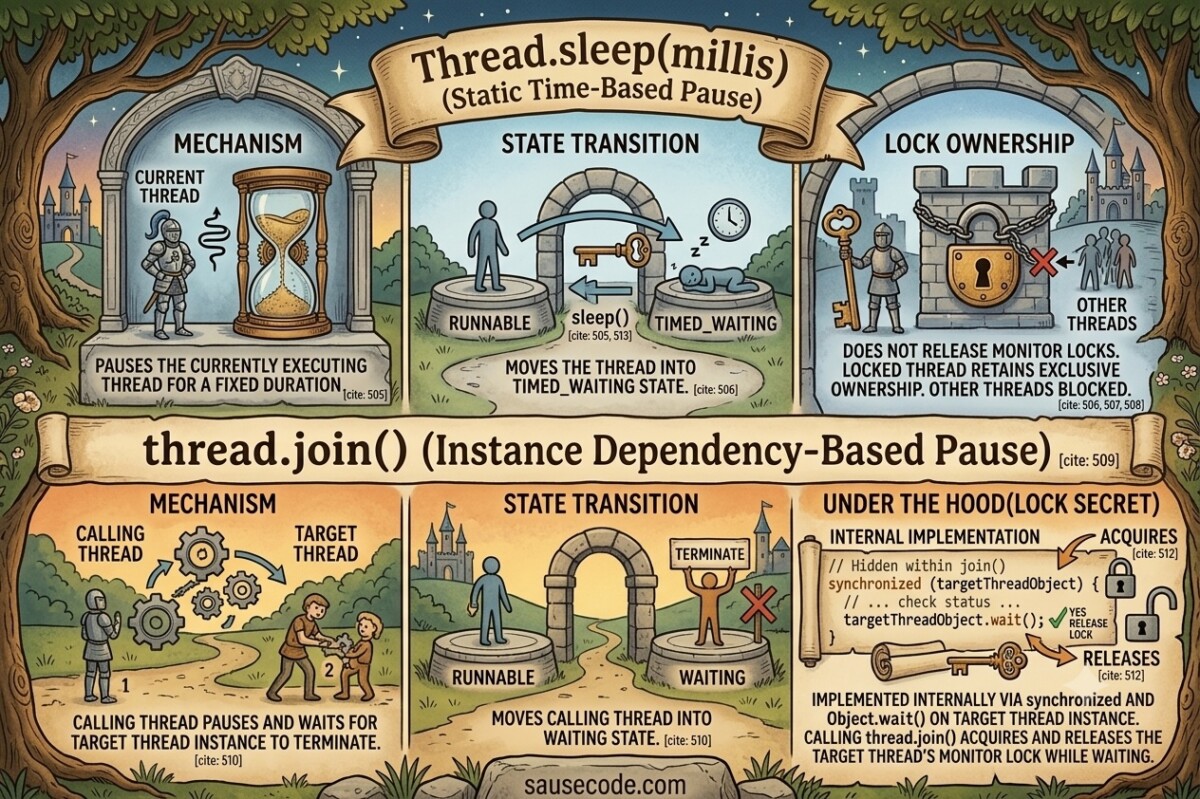
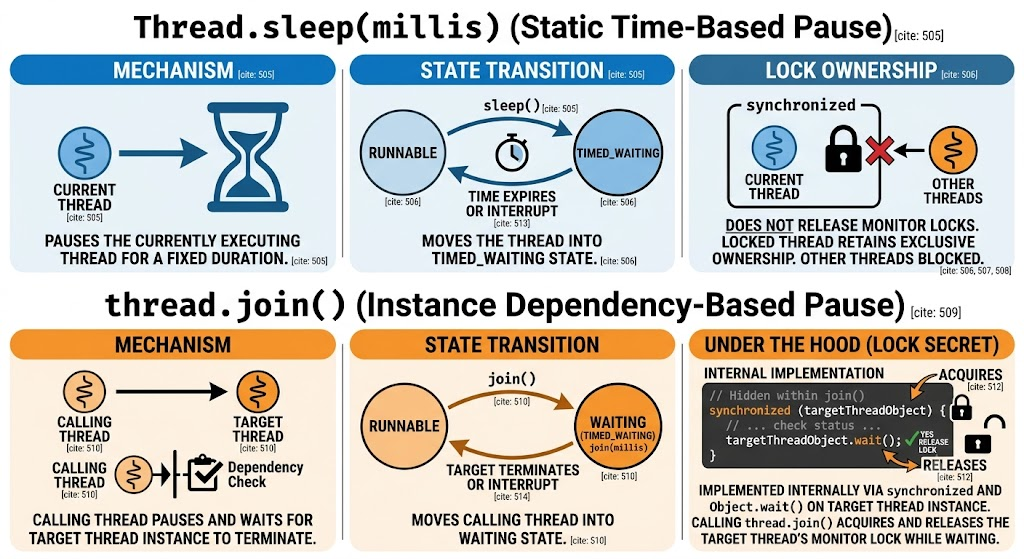
Thread.sleep(millis)(Static Time-Based Pause)- Mechanism: Pauses the currently executing thread for a fixed duration.
- State Transition: Moves the thread into
TIMED_WAITING. - Lock Ownership: DOES NOT release any monitor locks. If a thread calls
sleep()inside asynchronizedblock, it retains exclusive ownership of that monitor lock. Other threads attempting to acquire the lock remain completely blocked.
thread.join()(Instance Dependency-Based Pause)- Mechanism: The calling thread pauses and waits for the target
threadinstance to terminate (TERMINATEDstate). - State Transition: Moves the calling thread into
WAITING(orTIMED_WAITINGif callingjoin(millis)). - Under the Hood (The Lock Secret):
join()is implemented internally usingsynchronizedandObject.wait()on the targetThreadobject instance! Therefore, callingthread.join()actually acquires and releases the target thread’s monitor lock while waiting.
- Mechanism: The calling thread pauses and waits for the target
Comparison Summary
| Feature | Thread.sleep(ms) | thread.join() |
|---|---|---|
| Type | Static method (Thread.sleep) | Instance method (t.join()) |
| Wake-up Trigger | Time expiration or InterruptedException | Target thread termination or InterruptedException |
| Monitors/Locks | Holds all acquired locks | Releases lock on the target thread object (via internal wait()) |
| Primary Use Case | Rate limiting, polling delays | Thread coordination / sequencing (e.g., Task A must finish before Task B) |
Code Example
This concise example demonstrates forcing a main thread to wait for two worker threads to complete their setup before proceeding.
public class ThreadJoinDemo {
    public static void main(String[] args) throws InterruptedException {
        Thread dbInit = new Thread(() -> {
            System.out.println("DB Thread: Initializing database connection pool...");
            try { Thread.sleep(600); } catch (InterruptedException e) { Thread.currentThread().interrupt(); }
            System.out.println("DB Thread: Database ready.");
        });

        Thread cacheInit = new Thread(() -> {
            System.out.println("Cache Thread: Warming up Redis cache...");
            try { Thread.sleep(300); } catch (InterruptedException e) { Thread.currentThread().interrupt(); }
            System.out.println("Cache Thread: Cache warmed.");
        });

        dbInit.start();
        cacheInit.start();

        System.out.println("Main: Waiting for DB and Cache initialization to finish...");

        // Main thread blocks at these points until each target thread completes
        cacheInit.join();
        dbInit.join();

        System.out.println("Main: Application initialization complete! Server listening on port 8080.");
    }
}